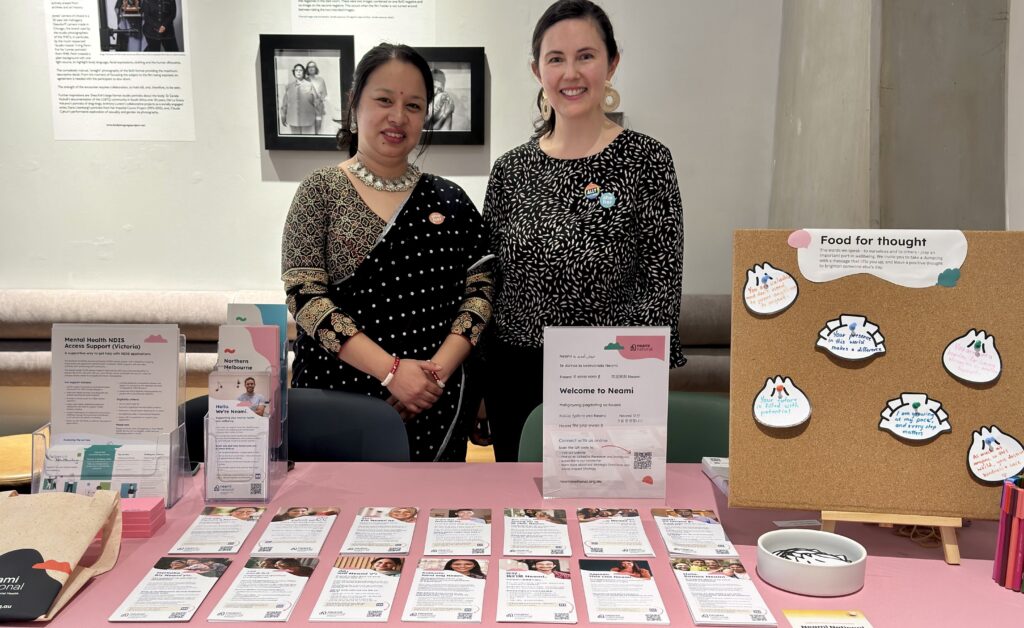
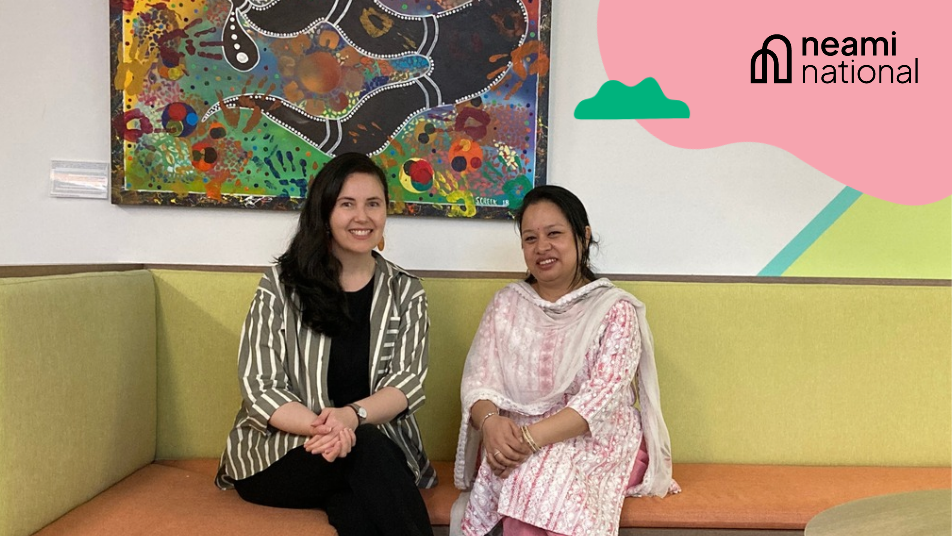
Meaningful engagement with diverse communities is built through connection, shared learning and bridging different perspectives. In that spirit, Resika KC, Service Manager at Northern Melbourne Psychosocial Support Service (right), and Narissa Doumani, Engagement Advisor – Services, reflect together on the value of this work and their experiences working with diverse communities.
Resika is a migrant from Nepal whose migration experience inspires her passion for amplifying multicultural voices and working with communities to advance equitable, culturally responsive mental health care.
Narissa is a Thai-Lebanese Australian who is passionate about community-centred approaches to inclusion and wellbeing, and creating spaces where diverse perspectives are heard and valued.
What role does community engagement play in providing support to diverse communities?
Resika KC: Speaking from my experience of engaging multicultural and multifaith communities, relationship-building with community is important for an individual to trust your service or trust you as a worker.
If they see that their community trusts you, their trust starts building from that. That creates accessibility and it’s a reciprocal relationship.
Narissa Doumani: I agree, community engagement is such an important part of making services relevant and accessible.
If we build genuine relationships where we listen and learn from each other, it helps us understand community needs and perspectives as they evolve. Then we’re able to better respond in ways that are meaningful to communities.
RKC: People also don’t know what we’re doing internally as an organisation to upskill our teams unless we are stepping up and being clear, reaching out to communities to let them know we’re here and we value them as part of our broader community.
How do we make services more accessible to multicultural communities?
RKC: You have to work with communities. It really matters. You need to consider what your service looks like to someone who walks in, or your website. You need to look at how diverse your workforce is to build that trust.
ND: I agree those are vital. Community engagement can help improve service awareness, but that doesn’t mean much if your services aren’t culturally safe and responsive.
Another issue is that mainstream services tend to be very western-centric in our understanding of mental health and approach to support. That often doesn’t feel accessible to people from different cultural backgrounds.
We talk about decolonising our practice, which means questioning some of the assumptions our services are built on and making space for different ways of understanding and relating. It requires us to be in community with people with different world views and to be open to change.
We also need to broaden our understanding of wellbeing. For example, in the west people often talk about self-care as a very individual practice, whereas in many cultures, it can’t be separated out from the collective.
RKC: Genuine community engagement is the key to understanding some of that for mental health organisations like ours. For many people, speaking with someone once a week or fortnight in a one-on-one closed environment doesn’t work. Their wellbeing may be linked with their collective unit, whether that’s family or community, and that’s not taken into consideration.
We risk creating barriers when individual support is the only option available, without considering whether it meets a person’s needs. Unfortunately, sometimes we’re not set up to work with families or community groups, so that’s a challenge.
How do we overcome mental health stigma in communities?
ND: I know Resika often questions our role in destigmatising mental health. I agree we need to challenge our thinking about stigma in multicultural communities. Too often, it’s seen as their problem, not ours.
Community engagement is a great entry point to working through this. We need to be part of the conversation with communities, giving them the chance to be curious and discuss mental health and wellbeing in a way that’s meaningful in their cultural context.
We can share information without expecting people to understand wellbeing through the same cultural lens. It’s about connecting, human to human, around experiences that can affect any of us, even if we have different ways of describing or making sense of them.
RKC: I also think language is such a key to supporting communities around mental health stigma. I like to say, ‘if you break a leg, you’re not a problem. The broken leg is the problem. You go to the doctor and ask for support and fix it. And then you ask for people in your family, community to support you while that is being treated.
‘Similarly, if your mental health and emotions are wobbly, that’s the problem. You’re not the problem. So you access support and ask others in family and community to scaffold you while you are getting support for that as well.’
The way we use language and explain things can be very simple, but what we’re really doing is creating another way of seeing.